FaraEDA takes the hardware baseline and runs the whole path to a verified, fab-ready board: partition into functions, define each circuit in words before wires, select real parts, wire the connective tissue, check as it goes. Every move arrives as a reviewable card with a reason. You approve; it never just does.
This is FaraEDA mid-design on our TC5 golden project. The header says 405 blocking · 17/44 verified · synthesis incomplete because that's the truth of this design at this moment. The Synthesis Coach on the right is explaining a duplicate-block card — and advising the engineer not to blanket-merge, because the three “transceivers” are different silicon that happen to share a name.
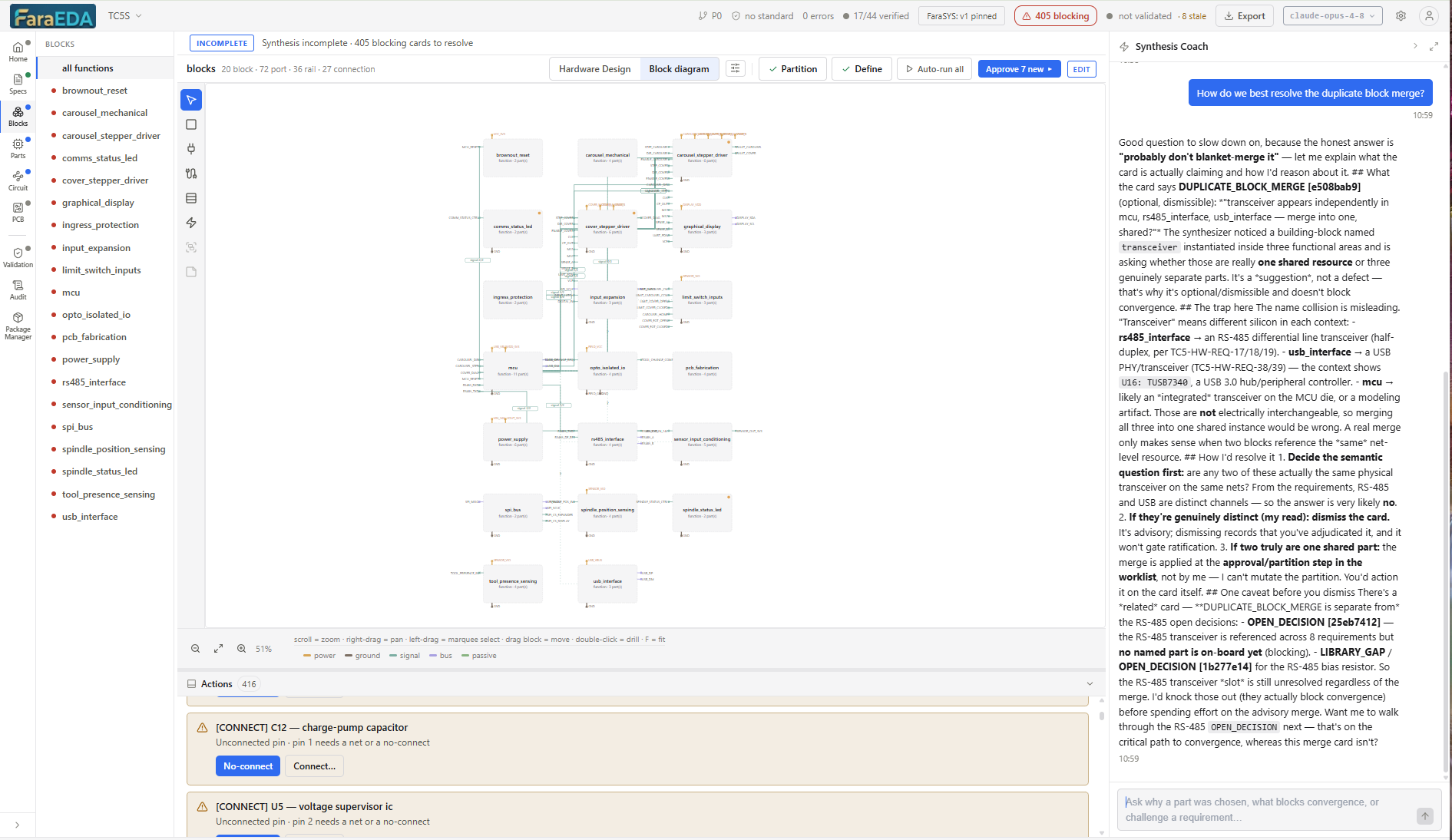
A design tool that always says yes is a liability. FaraEDA keeps a typed queue of everything unresolved — unconnected pins, open decisions, library gaps — and refuses to call the design done while any of it blocks. When it can't close the loop, it names exactly why.
Give the agent a goal and it works across the board: defining circuits, choosing parts, wiring, fixing issues. Every move is a two-door confirm card with the change and the reason. Accept, reject, or edit at any granularity. Nothing lands on your board without your call, and everything is reversible.
Before a single symbol is placed, each function gets a written design: what it does, which requirement asks for it, what parts it needs, how it connects. The circuit follows the words, and the words quote the requirement. That's what makes the trace real instead of decorative — and it's why a reviewer can read the design, not reverse-engineer it.
The baseline partitioned into named functions, human-approved.
Per-circuit design spec, quoting the requirements it serves.
Grounded selection, typed interfaces, named nets.
KiCad, Altium, Cadence, Gerber, ODB++, IPC-2581.
Language models hallucinate part numbers. Ours isn't allowed to: selection happens from a verbatim shortlist out of a real catalog, with lifecycle, qualification, and stock surfaced right there. If the catalog has nothing suitable, you get a library-gap card — an honest hole, not an invented component.
Divider ratios, regulator headroom, RC constants, trace widths: anything derivable by formula is computed by a checks library, not judged by a model. ERC runs continuously. The model's own numbers land as unverified until a computation passes them — the same rule we apply to humans.
Each confirm card you accept becomes an entry in an immutable, diffable history: who changed what, when, and why — agent and human distinguished. For certified work, that trail is configuration-management evidence you'd otherwise assemble by hand.
Clean export to the industry formats, netlist import from the tools you're leaving behind, and an open MCP interface so your own AI assistant can drive the canvas.
FaraEDA builds against the baseline FaraSYS publishes and owes evidence back: design disclosures traced to requirements, change requests when the requirements need to move, and check results stamped with how they ran. Its sibling FaraSW does the same for the firmware that will run on this board — same project, same spine, traces meeting at the top.